Rank and Rent is a digital marketing business model where you build a website, optimise it to rank on page one of Google for valuable local search terms, and then rent that website - along with the leads it generates - to a local business for a flat monthly fee. Unlike traditional client SEO where you rank someone else's website and lose everything when they leave, rank and rent means you own the asset: the domain, the rankings, the phone numbers, and the lead flow. Craig Riley has been building and renting websites for over 10 years across dozens of industries including plumbing, roofing, HVAC, legal services, pest control, tree removal, and landscaping. A single rank and rent site can generate $500 to $3,000+ per month in recurring passive income, and a portfolio of 10–20 sites can generate $60,000 to $720,000+ per year - making it one of the most reliable and scalable online business models for digital marketers who understand SEO.
The Definitive Guide to Rank & Rent
I started building and renting websites before the model had a name. While other marketers were chasing retainers and losing clients to cheaper agencies, I was building digital assets that I owned, ranked, and monetised month after month. Over 10+ years, I've built rank and rent sites across plumbing, roofing, HVAC, pest control, tree removal, landscaping, legal services, dental practices, and more.
The rank and rent model is beautifully simple in concept: you build a website targeting local service keywords (“plumber in Denver,” “roofer near me”), rank it on Google, and then rent it to a local business that wants those leads. The business pays a flat monthly fee for the phone calls, form submissions, and enquiries. You keep the site, the rankings, and the phone numbers. If one tenant stops paying, you redirect the leads to the next business in line.
What makes rank and rent fundamentally different from other digital marketing models is ownership. In client SEO or PPC management, you build value on someone else's platform. In rank and rent, every hour you invest builds equity in a digital asset you control. That asset appreciates as it ages, gains authority, and generates increasingly valuable leads.
This page is my complete methodology - the exact system I've refined over a decade and hundreds of successful sites. From niche selection and market research to site building, ranking strategies, proving lead flow, finding your first paying tenant, and scaling a full portfolio, every step is detailed below. I've also included real revenue examples, common mistakes to avoid, and how integrating The Full Search Stack (SEO + AEO + GEO) gives rank and rent sites a massive competitive advantage in 2026.

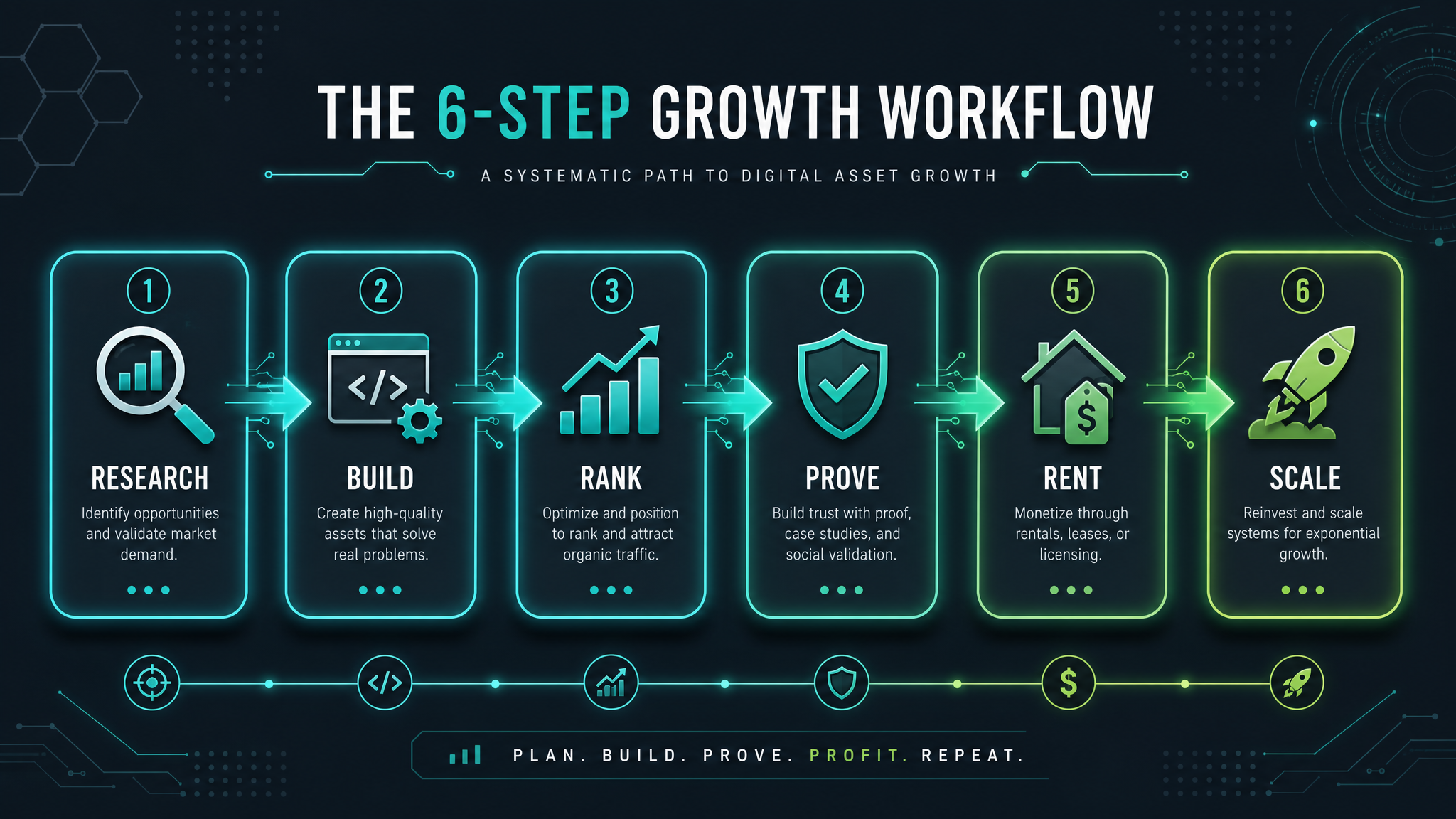
My 6-Step Rank & Rent Process
This is the exact framework I've refined over 10+ years and hundreds of websites. Every step is battle-tested in live markets against real competition. No theory - just what actually works.
Step 1: Niche & Market Research
I start every rank and rent project with data, not gut feeling. I analyse search volume using tools like Ahrefs and SEMrush, evaluate competition levels by manually reviewing the top 10 results, calculate average job values from industry data, and assess local business density to understand demand.
- Identify niches with high customer lifetime value - plumbing ($500–$5,000 per job), roofing ($5,000–$20,000+), HVAC ($3,000–$10,000), and legal services ($2,000–$50,000+) consistently outperform
- Analyse urgency-driven searches - "emergency plumber near me" converts at 3–5x the rate of informational queries
- Evaluate local business density - you need at least 15–20 businesses in the area who could be potential tenants
- Check Google Maps saturation - if the local pack is dominated by well-established brands with hundreds of reviews, consider a smaller market
- I've tested over 40 niches in the past decade and maintain a proprietary ranking of which ones deliver the best ROI based on difficulty-to-revenue ratio
Step 2: Build a Conversion Machine
The website needs to do two things exceptionally well: rank and convert. I build fast, mobile-first sites with a laser focus on turning visitors into leads. Every single element on the page - from the headline to the footer - is designed with one purpose: generate a phone call or form submission.
- Mobile-first design with page speed scores above 90 - over 60% of local searches happen on mobile devices, and Google uses mobile-first indexing
- Click-to-call buttons positioned above the fold and repeated in every section - making it effortless for someone in an emergency to call
- LocalBusiness schema markup, Service schema, and FAQ schema - structured data is non-negotiable for local SEO in 2026
- Conversion-optimised landing pages with social proof elements, trust badges, and clear service area information
- I typically build 5–10 inner pages targeting service variations and location modifiers to capture long-tail traffic (e.g., "drain cleaning in [city]" alongside "plumber in [city]")
Step 3: Rank It on Page One
This is where 19 years of SEO experience compounds. Ranking a rank and rent site requires a coordinated strategy across on-page optimisation, off-page authority building, and local search signals. There are no shortcuts - but there are efficiencies that come from knowing exactly which signals Google weights most heavily for local results.
- On-page optimisation - title tags, H1s, content silos, internal linking, image alt text, and meta descriptions all crafted for the target keywords
- Google Business Profile setup and optimisation - a verified GBP listing with consistent NAP, relevant categories, and regular posts is critical for local pack visibility
- Local citation building - I submit to 50–100+ directories with perfectly consistent name, address, and phone number information
- Strategic link building - guest posts, local sponsorships, niche-relevant directories, and digital PR to build genuine domain authority
- Content creation targeting supporting long-tail keywords - a blog with 10–20 locally-relevant articles strengthens topical authority and captures informational searches
Step 4: Prove the Lead Flow
Before approaching any business, I let the site generate real, verified leads - phone calls, form submissions, and Google Maps enquiries. This proof period typically lasts 2–4 weeks and is absolutely crucial. When I show a potential tenant a call tracking dashboard with 20–50 real calls from real customers, the conversation changes entirely.
- Set up call tracking with recorded lines - I use services that provide a local number, record calls, and log timestamps so tenants can verify lead quality
- Install form tracking and analytics - every form submission, click-to-call tap, and direction request is logged and reportable
- Document the quality and volume of leads over a 2–4 week proving period before making any outreach to potential tenants
- The proof removes all objections - the conversation shifts from "Can you actually do this?" to "How much and when can we start?"
- This approach means you never need to cold-pitch a service - you are offering a proven, quantifiable asset
Step 5: Rent It for Recurring Revenue
With proof of leads in hand, I contact local businesses in the niche and offer them the leads for a flat monthly fee. No long-term contracts. No complicated revenue shares. No performance clauses. A simple monthly rental agreement - they pay, they get the calls. If they stop paying, I redirect the calls to the next tenant.
- Rental pricing typically ranges from $500/month for lower-value niches in small markets to $3,000+/month for high-value niches (plumbing, roofing, legal) in competitive metros
- I always start by contacting businesses that are already advertising on Google Ads - they understand lead value and are used to paying for customer acquisition
- Month-to-month agreements protect both parties - the tenant can cancel anytime, and you can find a better-paying tenant if demand warrants it
- You own the website, domain, phone numbers, and rankings - the tenant is renting access to the lead flow, nothing more
- Some practitioners prefer a per-lead model ($25–$150 per qualified lead), but I prefer flat-rate rentals for predictable recurring income
Step 6: Scale Your Portfolio
Once you have one site profitable and running on autopilot, you repeat the process. Different niche, different city, same battle-tested methodology. Each site in your portfolio is a completely independent revenue stream. The portfolio model is what transforms rank and rent from a side project into a genuine scalable business.
- Each additional site follows the same 5-step process - the learning curve accelerates dramatically after your first 2–3 successful sites
- Diversify across niches and geographies to protect against market-specific downturns or algorithm shifts
- I typically spend 15–20 hours building and launching a new site, then 2–5 hours per month maintaining it once it's ranking and rented
- At scale, systems matter - I use standardised templates, checklists, and SOPs for every step so that each new site is built to the same proven standard
- A portfolio of 10–20 sites each generating $500–$3,000/month creates a $60,000–$720,000/year business with minimal ongoing overhead
Real Revenue Examples
These are representative monthly rental figures from actual rank and rent sites I've built or consulted on. Results vary based on niche competition, location size, and lead quality.
$1,800/mo
Mid-size US city • 6 weeks to rank
$2,500/mo
Competitive metro • 4 months to rank
$750/mo
Small market • 5 weeks to rank
$1,200/mo
Suburban area • 8 weeks to rank
$2,000/mo
Mid-size city • 3 months to rank
$900/mo
Growing suburb • 6 weeks to rank

Why Rank and Rent Works Better Than Client SEO
I spent the first several years of my career doing traditional client SEO - ranking other people's websites and charging monthly retainers for the privilege. It works, and I still do it selectively, but I learned the hard way that client SEO has a fundamental flaw: you never own the asset.
When a client fires you - and they will, eventually, for reasons that often have nothing to do with your performance - you walk away with nothing. The rankings you built belong to them. The content you created belongs to them. The backlinks you earned point to their domain. Months or years of work, and you start from zero with the next client.
Rank and Rent inverts this dynamic completely. You own the website. You own the domain. You own the phone number. You built the rankings on your property, and those rankings generate leads whether or not someone is currently paying you for them. If a tenant leaves, the leads keep flowing - you just redirect them to the next business in line.
This is the difference between building a service and building an asset. A service trades time for money. An asset generates money whether you're working or not. After more than a decade of doing both, I can tell you unequivocally: building assets is the better path.
The other advantage is pricing power. In client SEO, you're competing against every freelancer on Upwork and every agency with a Facebook ad. The client has all the leverage because there are a hundred people offering the same service. In rank and rent, you have a ranking website generating real leads - there is no competition for that exact asset. You set the price, and the business either values the leads or they don't.
Rank & Rent vs Client SEO: Side-by-Side Comparison
| Factor | Rank & Rent | Client SEO |
|---|---|---|
| Asset Ownership | You own everything | Client owns everything |
| If client/tenant leaves | Keep rankings, find new tenant | Lose everything |
| Income Model | Passive recurring revenue | Active service retainer |
| Pricing Power | You set the price | Competing with every agency |
| Scalability | Build portfolio of sites | Limited by capacity |
| Time to Revenue | 2–6 months per site | Immediate (but fragile) |
| Risk Profile | Low - diversified portfolio | High - client concentration |
| Long-term Value | Appreciating digital assets | Trading time for money |
5 Mistakes That Kill Rank and Rent Profits
I've made every one of these mistakes at some point. Learning from them cost me tens of thousands of dollars in lost revenue and wasted time. Save yourself the pain and avoid them from the start.
Choosing Niches Based on Passion, Not Profit
I see beginners target niches they find interesting rather than niches with proven revenue potential. A yoga studio lead is worth $50. A roofing lead is worth $5,000. Rank and rent is a business - choose niches where the numbers work.
Building Beautiful Sites That Don't Convert
A rank and rent site is not a portfolio piece. It's a lead generation machine. I've seen gorgeous websites that generate zero phone calls because there's no clear call to action, no phone number above the fold, and no urgency in the copy. Function over form, always.
Giving Up After 8 Weeks
SEO takes time. Most beginners quit just as their site is about to break through. I've seen sites jump from page 3 to the local pack in a single week after 3 months of steady work. If you've done the research and built properly, trust the process.
Not Tracking Leads Properly
If you can't show a potential tenant exactly how many calls came in, when they called, and what they asked about, you have nothing to sell. Call tracking and form analytics are not optional - they're the foundation of your tenant pitch.
Underpricing the Rental
Many beginners undervalue their leads because they want to secure a tenant quickly. A plumbing lead that converts into a $3,000 job is worth hundreds of dollars, not $20. Know the customer acquisition cost in your niche and price accordingly.
Rank and Rent in 2026: The Full Search Stack Advantage
Most rank and rent practitioners in 2026 are still operating like it's 2018 - build a site, do basic SEO, rank it, rent it. And while that still works in lower-competition markets, the landscape has shifted dramatically with the rise of AI-powered search.
Google now shows AI Overviews for a growing percentage of local searches. ChatGPT has integrated real-time search results. Perplexity provides cited answers that pull from web sources. If your rank and rent site only shows up in traditional blue links, you're missing an increasingly large share of visibility.
This is why I developed The Full Search Stack - a framework that combines traditional SEO with Answer Engine Optimisation (AEO) and Generative Engine Optimisation (GEO). When I build a rank and rent site now, it's not just optimised to rank on Google - it's structured to appear in featured snippets, People Also Ask boxes, voice search results, and AI-generated answers.
The result is a rank and rent site that captures leads from every channel - not just traditional organic search. Sites built with the Full Search Stack consistently outperform single-channel sites by 40–60% in total lead volume, which translates directly into higher rental fees and more reliable tenant retention.
If you want to future-proof your rank and rent business, learning and applying SEO, AEO, and GEO together is no longer optional - it's the new baseline. I teach this complete methodology in my upcoming Rank & Rent Masterclass.
Who Is Rank and Rent Right For?
Rank and rent is not a get-rich-quick scheme. It requires real SEO skills, patience while sites rank, and the discipline to follow a proven process. That said, it's one of the most accessible online business models for anyone willing to put in the work.
SEO Freelancers
You already have the skills. Rank and rent lets you use those same skills to build assets you own instead of exclusively trading time for client retainers.
Agency Owners
Add rank and rent to your service portfolio as a recurring revenue stream that doesn't depend on client retention. Use your existing processes to scale faster.
Side Hustle Builders
If you're learning SEO and want a business model with genuine long-term potential, rank and rent gives you a tangible, valuable asset at the end of each project.
Real Estate Investors (Digital)
If you understand the concept of buying, improving, and renting physical property, rank and rent is the digital equivalent - with lower capital requirements and higher margins.
Want the Full Rank & Rent Masterclass?
I'm building a comprehensive course covering everything from site selection to scaling a portfolio. Join the waitlist to be first in.